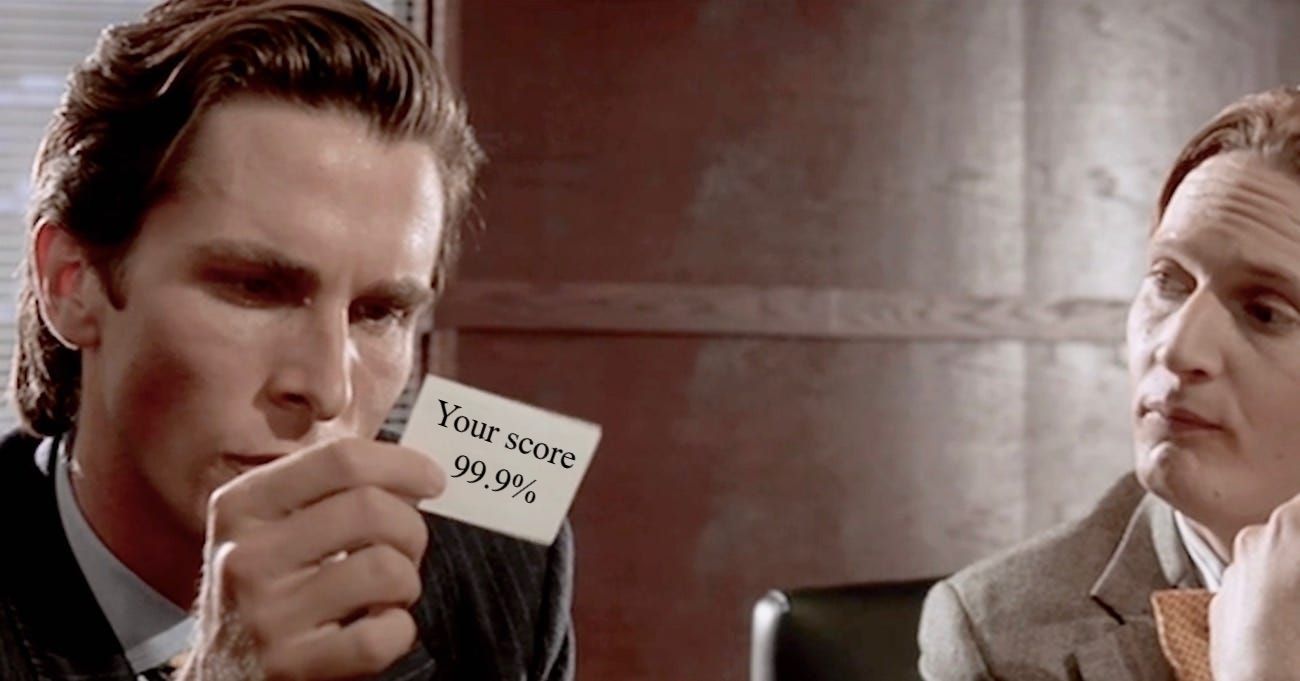
The rise of the highly motivated
Across the internet, there's a humorous list of mental disorders that make us suitable for various professions. The humor is based on exaggerating the supposedly characteristic traits of various occupations, taken to extremes. IT professionals are diagnosed with autism, writers with alcoholism, bloggers with narcissism, financiers with OCD, and so on.
Not every profession attracts extreme personalities. But the more competitive and prestigious something becomes, the more likely it is to be dominated by people who are… a bit unusual.
This isn’t accidental. Real excellence, in most fields, requires something beyond just following rules or executing known patterns. It requires going further — pushing beyond what is strictly necessary. And convincing a normal, well-adjusted person to consistently do more than what is required is not easy. In fact, it’s rare.
More often than not, people who are willing to push themselves far beyond the baseline are driven by something deeper — something that doesn’t always look like balance. Modern systems don’t explicitly reward this, but they quietly depend on it.
In highly competitive environments, moderation is rarely a winning.
In places like startups or venture capital access has never been easier — anyone can try. But success is more concentrated than ever. The winners are not just building companies; they are pushing growth at a pace that often ignores long-term reality. The system doesn’t demand this behavior, but it consistently rewards it.
On the other side of the globe this you see these dynamics even before people enter the system — at the stage where they are trying to get in.
In countries like China and South Korea, access to top universities is filtered through a single high-stakes exam. Millions of students compete for a tiny number of places, and the difference between success and failure can come down to a few points on a single day. In China, entry into the very top universities can mean 300-500 applicants for one seat. Even in less elite institutions, competition for the most prestigious fields — like finance or computer science — can reach dozens or even hundreds of candidates per place. link link link
What this creates is not just competition, but a kind of selection pressure that goes beyond intelligence. Students study for 10–14 hours a day, often for years, training not just their knowledge but their endurance. At that level it’s clear what social pressure and such a regime do to the mental health of a young person.
It wasn’t always like this
It’s not even clear that things were always this way. In the distant past, there were certainly eccentric people — but not nearly as many in positions of influence.
For most of history, people didn’t compete for professions in the way we do now. They inherited them. Blacksmiths raised blacksmiths, merchants raised merchants. Most people lived within a structure they didn’t have to fight to enter, and because of that, most people were fairly normal.
Back in, say, the seventeenth century, elites were no doubt decadent and morally compromised — but since people tended to reach the upper branches of society not through extraordinary effort, but simply by birth, those elites contained a higher share of fairly ordinary, unremarkable individuals than our modern democratic age does.
And it was precisely this ordinariness — this lack of brilliance, this attachment to nothing more than familiar, everyday vices (rather than extravagant, exotic ones) — that acted as a kind of stabilizing buffer, preventing the whole system from spinning out of control.
Geniuses existed, of course, but they were exceptions — often people who combined inherited skill with genuine personal passion.
There was also another factor. In creative families, competition existed, but it was local and contained.
Take Gerald Durrell. He became widely known as a writer and naturalist, but for a long time his success was overshadowed by his older brother, Lawrence Durrell, who was considered the more serious author.
In a different context, Gerald Durrell might never have written at all. Access to tools and opportunities was limited — even owning a typewriter in the 1930s was a barrier.
The 20th century changed that. Today, your parents’ profession predicts very little about your own. Many fields became more accessible, but at the same time far more competitive. And the more people enter a system, the harder it becomes to stand out.
This creates a strange paradox. A system that once seemed fair increasingly selects for the most extreme traits—not necessarily the wisest or most balanced, but the most determined.
The history of one democracy
For a long time, it has been customary to believe that in mature Western societies there exists a functioning system of checks and balances — a mechanism that filters out the occasional lunatic and ensures that sensible moderation ultimately prevails.
It may be worth taking a closer look at what this “sensible middle” actually looks like in practice.
Yesterday, I came across a lament in The Guardian about a curious situation in the democratic kingdom of Denmark: voters, having decisively rejected “centrist” parties in recent elections, may nonetheless end up with yet another centrist government. The author writes:
“Our [Danish] style of parliamentary politics has long been admired internationally, but last week’s general election has thrown it into crisis. The result amounted to a public vote of no confidence in the centrist government led by Social Democrat Mette Frederiksen. Her administration represented an unusual political arrangement in the Danish context. In 2022, Frederiksen broke with long-standing tradition by forming a governing alliance between centre-left and centre-right parties. Yet the most likely outcome of the election is that Denmark will once again have a centrist government. It is a kind of democratic boomerang. Through a quirk of parliamentary logic, what voters reject ends up coming back to them. This paradox might be called the tyranny of 10%: if 45% of voters want a left-wing government and 45% want a right-wing one, but 10% vote for centrist parties, it becomes extremely difficult for either side to form a government.”
Translated into plain terms, the complaint is this: in the past, Denmark alternated between left and right governments — and things functioned well enough, because those in power were, more or less, the ones people had voted for. Now voters choose left or right, but power ends up in the hands of those whom almost no one explicitly chose — simply because they hold the deciding share.
But that is not the most interesting part.
For decades, Denmark has been governed — in turn — by the left, the right, and, more recently, by the centre. Yet from the outside, it is increasingly difficult to tell what, exactly, makes any of them “left”, “right”, or even “centrist” in the first place.
Under a government associated with left-leaning, animal-rights, and environmentalist ideals, Marius the giraffe was publicly euthanized and dissected before children in Copenhagen; under firm conservatives, Denmark emerged as a global pioneer in legalizing same-sex partnerships.
I was told a remarkable story about the period 2022-2024, when all of Denmark began to consider itself the ruler of the world thanks to Novo Nordisk, a national drugmaker that in 2022 was supplying the world with drugs like Wegovy and Ozempic. At its peak (in the summer of 2024, when the company's market capitalization exceeded Denmark's GDP), all Danes were subjectively considered quite wealthy because almost everyone directly or indirectly owned shares in this company, whose market capitalization exceeded 600 billion.
And then similar products appeared on markets around the world, because the technology itself wasn't unique (and everyone knew it!). As a result, by the spring of 2026, Novo Nordisk's market capitalization had fallen threefold. Media reports indicate that "this poses a problem for the entire Danish economy, which is heavily dependent on the pharmaceutical giant." The GDP decline was 1.6% link. The question "Why didn't anyone see this coming?" remains.
This is just one example — it wouldn’t be hard to find more devastating ones today.
Modern politics does not reward competence as much as it claims to. What it reliably rewards instead is ambition — relentless, boundary-pushing ambition.
These are the traits that help people win in highly competitive systems. And once they do, the results are, at best, unpredictable. You don’t have to look far for examples.
France, for example, placed its trust in a figure — unconventional in ways that earlier generations might have found difficult to ignore.
In the UK, voters end up choosing the “better of the two.”
In the United States, voters often find themselves choosing between candidates from Epstein friendlist.
This isn’t entirely surprising — it’s a fairly predictable outcome of the system.
Is there any way out?
The author, unfortunately, offers no brilliant solution to the problem he describes. What we get instead is simply the diagnosis: our era seems remarkably efficient at mass-producing entry tickets to grand contests for power — contests in which the winners are often the most unhinged and eccentric participants, who then proceed to behave accordingly.
To the usual corruption — along with the familiar decline and moral decay that tend to accompany power — we now get an added bonus: a selection process that favors those who want it the most. And among that group, the percentage of deeply weird people is, unsurprisingly, off the charts.
Humanity has yet to invent a restraining mechanism or, rather, develop it through evolution. If the idea that everything has happened before is true, then the answer, presumably, will be the "cyberpunk neo-feudalism" taking shape today.
It will also have countless vices (well-known to us from feudalism long history), but it will perhaps mitigate the problem purely mechanically—by introducing into the elite alongside the maniacs also ordinary, essentially "random", but talented people who have gained power for a number of worthy reasons. And thereby diluting the intensity of the madness with a boredom that has long been absent.